


AVoIP 101: A Beginner’s Guide to Mastering Church Networks
- Tim Adams
- 4 days ago
- 6 min read
In the world of professional audio and video, technology rarely stands still. For decades, the standard way to move a signal from point A to point B involved dedicated cables. If you wanted to send a video signal, you ran an HDMI or SDI cable. If you wanted to move audio, you pulled XLR or TRS cables. While this "point-to-point" method is reliable, it is also rigid, difficult to scale, and often results in a massive tangle of "spaghetti" behind the tech booth.
As modern worship services grow in complexity: incorporating live streaming, overflow rooms, foyer displays, and multi-site broadcasts: traditional cabling often reaches its limit. This is where AVoIP comes in. AVoIP, or Audio-Visual over Internet Protocol, is a transformative approach that leverages standard computer networks to distribute high-quality media.
Understanding how to transition a church environment to this networked approach is no longer just an "IT thing": it is a fundamental part of building a durable, scalable AV system that can serve a congregation for years to come.
What Exactly is AVoIP?
At its core, AVoIP is the process of sending audio, video, and control signals over a standard Ethernet network. Instead of a physical cable acting as a one-way street for a single signal, the network acts as a massive highway where hundreds of different "packets" of data travel simultaneously.
When you use AVoIP, a source (like a camera or a laptop) sends its signal into an encoder. This device translates the video or audio into data packets. These packets are sent through a network switch: the same kind of hardware used for office computers and internet: to a decoder. The decoder then translates that data back into a signal that a projector, monitor, or speaker can understand.
This shift from hardware-based switching to software-based routing is the most significant change in professional services for the AV industry in the last twenty years.
Why This Matters for a Church Environment
The benefits of moving to a networked system are particularly impactful for a house of worship. Unlike a corporate office, a worship space often requires high flexibility on a weekly basis.
1. Massive Scalability
In a traditional setup, if you have an 8x8 video matrix switcher, you can only have eight inputs and eight outputs. If you decide to add a ninth TV in the youth room, you have to buy a completely new, larger, and very expensive switcher. With AVoIP, scaling is as simple as adding another encoder or decoder to the network. There is no hard limit other than the bandwidth of the network itself.
2. Long-Distance Distribution
HDMI cables have a notorious "cliff." Once you try to run them longer than 50 feet, the signal often degrades or disappears entirely. SDI is better, but it still has physical limitations. Network cabling (like Cat6) can reliably carry data over long distances, and when paired with fiber optics, it can send 4K video across an entire campus without a drop in quality.
3. Simplified Infrastructure
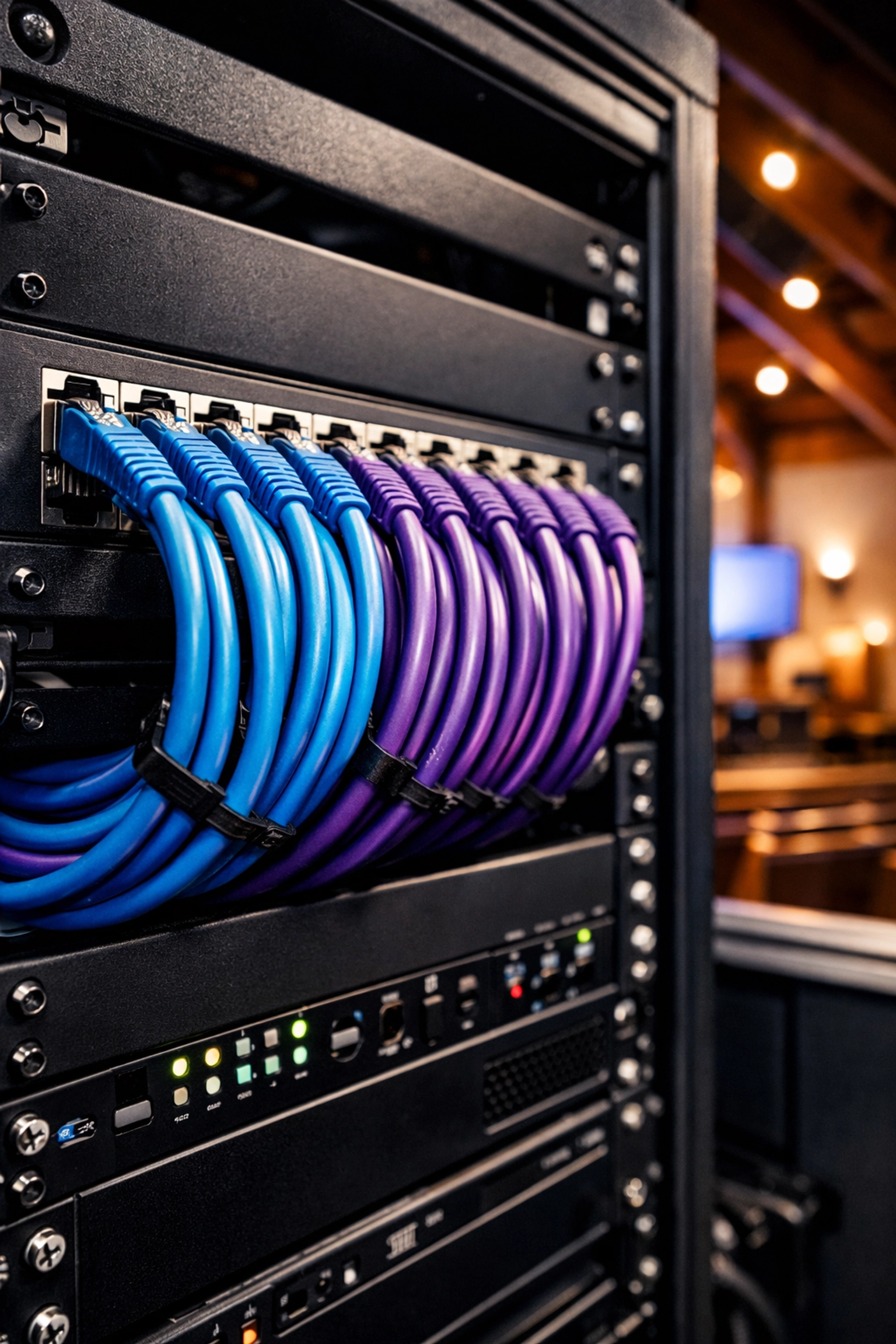
Instead of pulling dozens of different types of cables through the ceiling, a church can install a robust "backbone" of shielded Cat6A or Fiber. This single type of cable can then carry audio, video, internet, and even power (via Power over Ethernet, or PoE) to the devices. This significantly reduces installation costs and makes troubleshooting much easier for volunteer teams.
Key Protocols You Need to Know
When researching AVoIP for a church project, you will encounter several acronyms. Understanding these is vital for ensuring different pieces of gear can "talk" to each other.
Dante (Digital Audio Network Through Ethernet)
Dante is the gold standard for networked audio. Created by Audinate, it allows for hundreds of channels of uncompressed audio to flow over a standard network with near-zero latency. Most professional digital consoles used in worship today are either Dante-enabled or have an expansion slot for it. It allows a sound tech to send a "split" of the audio to a broadcast room or a recording computer with a single click in a software interface.
NDI (Network Device Interface)
NDI is arguably the most popular video protocol for worship environments. It allows cameras and media computers to share high-quality video over the network. Because NDI is "auto-discovering," when you plug an NDI-capable camera into the network, your streaming software (like vMix, OBS, or ProPresenter) sees it immediately. This is a game-changer for volunteer-led teams who don't want to spend hours configuring IP addresses.
AES67
While Dante is a proprietary brand, AES67 is an open standard for audio-over-IP. It acts as a "translator" that allows different protocols (like Dante, RAVENNA, and Livewire) to communicate with each other. If you are building a system for the church that uses gear from multiple different manufacturers, AES67 compatibility is a must-have feature for long-term durability.
SMPTE ST 2110
This is a more advanced, broadcast-grade standard. It treats video, audio, and metadata as separate streams that are perfectly synchronized. While it is more complex and requires more expensive network hardware, it offers the highest level of control for large-scale broadcast operations.
The Importance of the Network Switch
If the encoders and decoders are the "cars" on the highway, the network switch is the "traffic controller." In a standard home network, a cheap switch is fine. However, for a church AV system, the switch is the most critical point of failure.
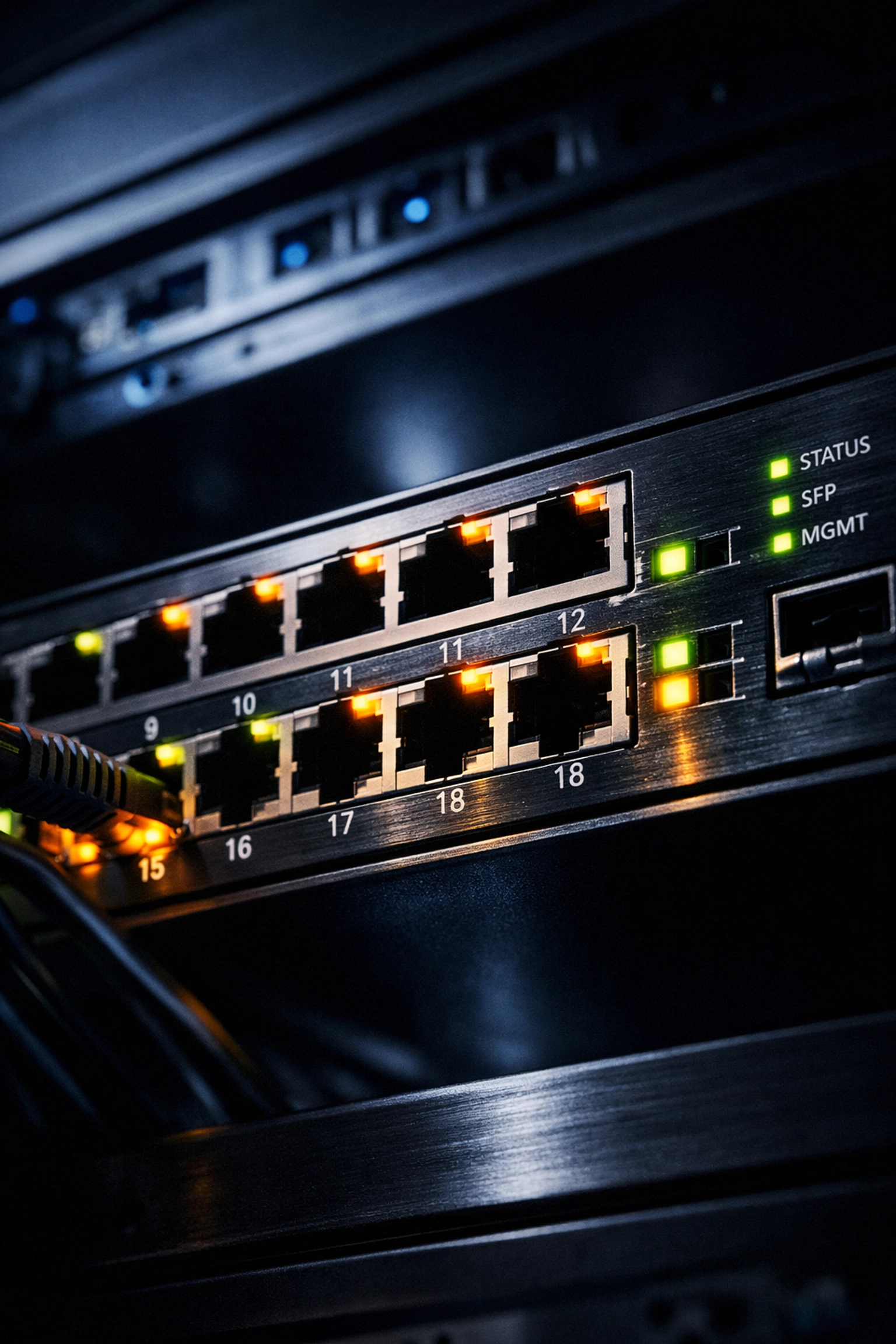
To handle the heavy load of real-time video, a "Managed Switch" is required. These switches allow technicians to configure Virtual Local Area Networks (VLANs) to keep AV traffic separate from general office internet or guest Wi-Fi. This prevents a congregant downloading a large file in the lobby from causing the lyrics on the main screen to lag or flicker.
For those looking into system design, prioritizing high-bandwidth, enterprise-grade switches is the only way to ensure the system remains stable during a live service.
Durability and Reliability in Ministry
At Timato Systems, we often emphasize that "pro-sumer" gear is rarely the right choice for a sanctuary. A church environment is unique because the equipment often sits idle for six days and then must perform at 100% capacity for several hours on Sunday.
AVoIP hardware designed for professional services is built to withstand this cycle. High-quality encoders are designed with passive cooling and robust power supplies to ensure they don't overheat or fail mid-sermon. When selecting gear, look for manufacturers that offer long-term support and firmware updates, as the software side of AVoIP is just as important as the physical box.
Common Pitfalls to Avoid
Even with the best technology, things can go wrong if the implementation is rushed. Here are three common mistakes to watch out for:
Underestimating Bandwidth: A single 4K NDI stream can take up 250Mbps of bandwidth. If you have four cameras and a few decoders on a 1Gbps switch, you are already hitting the limit. Always plan for "Headroom" by using 10Gbps uplinks between switches.
Using Non-Shielded Cables: Church buildings are often full of electromagnetic interference from lighting ballasts and power lines. Using shielded Cat6 (STP) ensures that the data packets aren't corrupted by outside noise.
Ignoring Latency: While AVoIP is fast, every "hop" through a switch or an encoder adds a few milliseconds of delay. If the latency gets too high, the audio won't match the speaker's lips on the screen (known as a lip-sync issue). Professional systems use Precision Time Protocol (PTP) to keep everything in sync.
Getting Started with Networked AV
Transitioning to AVoIP doesn't have to happen all at once. Many organizations start by implementing Dante for audio distribution and then slowly adding NDI cameras as the budget allows.
The first step is always the network infrastructure. If the "pipes" are installed correctly, the rest of the system can be upgraded modularly over time. This approach respects the financial stewardship of the organization while providing a clear path toward a modern, high-capacity system.
If you are currently evaluating your tech needs, exploring the blog-posts-sitemap.xml can provide more context on specific hardware choices and setup guides.
Conclusion
AVoIP is no longer a luxury for high-end broadcast studios; it is a practical, durable, and highly efficient tool for any modern worship space. By moving away from rigid physical cabling and toward a flexible network-based architecture, a church can ensure that its message is delivered clearly to every corner of the building: and beyond.
Whether you are looking to fix a "lip-sync" issue on your live stream or you are planning a complete renovation of a sanctuary, understanding the fundamentals of AVoIP is the best place to start. It provides the freedom to grow, the reliability to perform, and the simplicity to be managed by a dedicated team of volunteers.
For more information on professional AV solutions and system planning, visit our main site or check out our specialized projection packages to see how networked video can enhance your visual presentation.
Comments